

NQ, HQ, PQ, NTW & HTW Diamond Core Bits: Sizes, Differences and Selection Guide
Diamond core drilling is widely used in mineral exploration, geological investigation and rock sampling because it allows drillers to recover a continuous cylindrical core from the formation.
Among the most commonly encountered sizes are NQ, HQ, PQ, NTW and HTW. These names are sometimes treated simply as different drill bit sizes, but there is more behind them.
Understanding the difference between these systems is important when selecting a diamond core bit, core barrel and drilling accessories for a particular project.
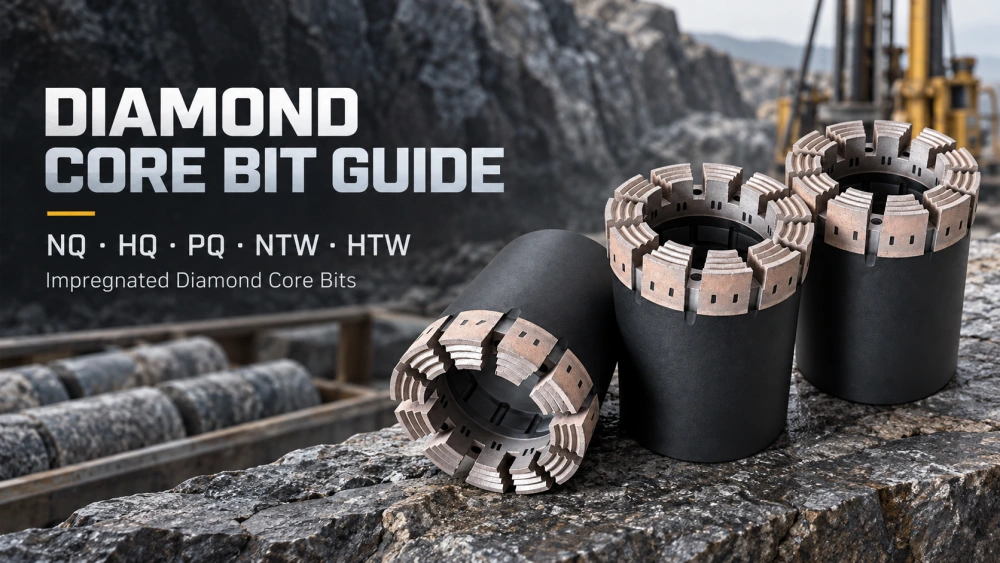
What Is an Impregnated Diamond Core Bit?
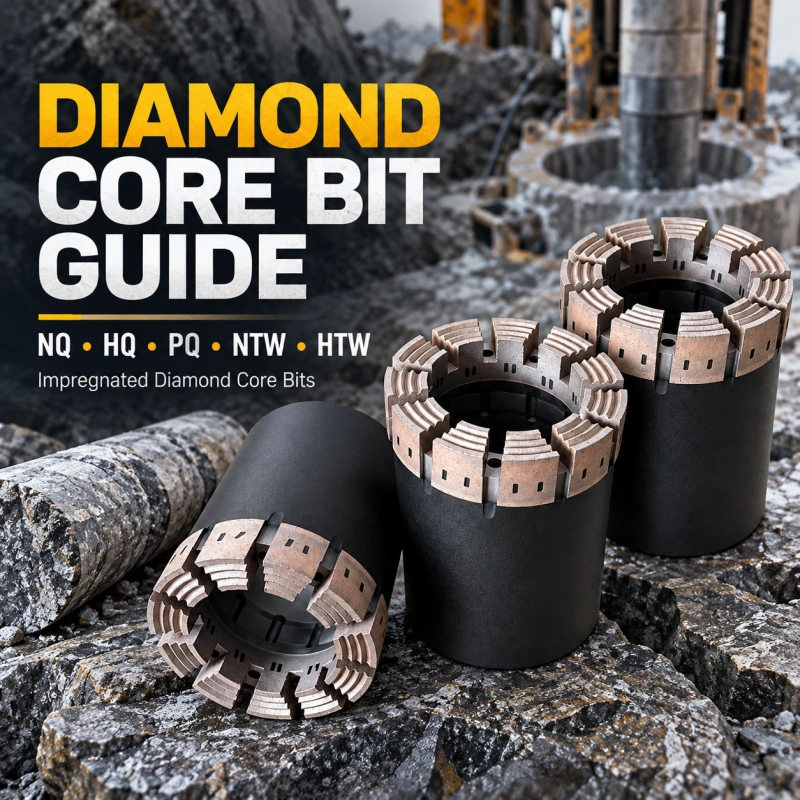
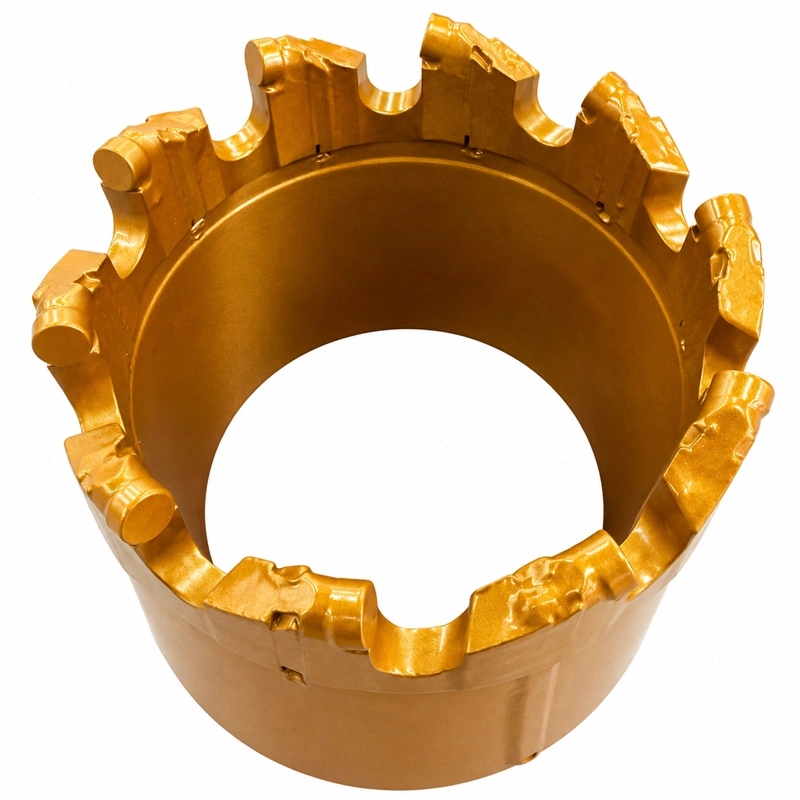
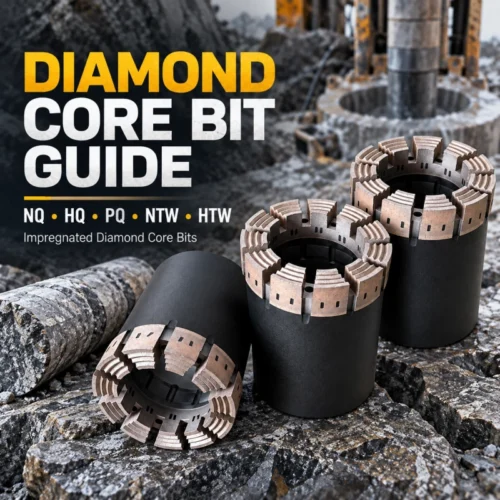
An impregnated diamond core bit uses synthetic diamond particles distributed throughout a metal matrix in the cutting crown.
During drilling, both the diamonds and the surrounding matrix gradually wear. As the matrix is abraded, new diamond particles are exposed and continue cutting the rock. This controlled wear mechanism is what gives an impregnated diamond bit its self-sharpening characteristics.
Boart Longyear describes impregnated diamond bits as tools intended primarily for medium to ultra-hard formations, with the metal-and-diamond matrix gradually wearing to expose new cutting diamonds.
This is fundamentally different from a surface-set diamond bit, where the cutting diamonds are concentrated mainly at the working surface.
In manufacturing, the diamond-bearing crown is produced through powder-metallurgy processes involving carefully selected metallic powders, synthetic diamonds, pressure and high temperature. In the drilling-tool market, these products are therefore also commonly referred to as hot-pressed diamond core bits.
The important point is not simply how the crown is manufactured. Actual drilling performance depends on the relationship between matrix characteristics, diamond size and concentration, rock abrasiveness and hardness, crown and waterway design, rotation speed, weight on bit, penetration rate, and flushing conditions.
A good diamond core bit is therefore not necessarily the hardest bit. It is a bit whose matrix wears at the correct rate for the formation being drilled.
NQ, HQ and PQ Are Coring Sizes — Not Rock-Hardness Grades
One misunderstanding we occasionally see is the assumption that NQ, HQ and PQ represent different hardness levels of diamond bits.
They do not.
They primarily identify different wireline coring system sizes.
Boart Longyear’s published Q-system specifications give the following nominal dimensions for standard NQ, HQ and PQ systems.
| Size | Approx. Core Diameter | Standard Bit OD |
|---|---|---|
| NQ | 47.6 mm | 75.3 mm |
| HQ | 63.5 mm | 95.6 mm |
| PQ | 85.0 mm | 122.0 mm |
These figures are nominal system dimensions. Actual dimensions can vary slightly according to bit gauge, reaming-shell configuration and manufacturer specifications.
NQ
NQ is one of the most widely used wireline coring sizes.
With a nominal core diameter of approximately 47.6 mm and a standard bit outside diameter of approximately 75.3 mm, it provides a practical balance between core size, drilling equipment requirements and borehole diameter.
For many mineral exploration and geological drilling programs, this balance makes N-size equipment a common choice.
HQ
HQ increases the nominal core diameter to approximately 63.5 mm, with a standard bit OD of approximately 95.6 mm.
The larger core gives geologists more material for geological logging, structural observation and sampling.
The trade-off is straightforward: a larger hole requires more rock to be removed and generally places greater demands on the drill rig, drill string, flushing system and overall drilling operation.
PQ
PQ is larger again, producing a nominal core diameter of approximately 85.0 mm with a standard bit OD of approximately 122.0 mm.
PQ may be selected when obtaining a large-volume core sample is particularly important or when project conditions justify the larger drilling diameter.
It should not automatically be considered “better” than NQ or HQ. The correct size depends on the geological objective, drilling depth, available equipment and the amount of core required.
What Are NTW and HTW Core Bits?
NTW and HTW belong to the thin-wall wireline coring family.
The concept is simple: by reducing the kerf and changing the geometry of the coring system, a larger diameter core can be recovered without increasing the hole diameter by the same proportion.
Typical nominal dimensions are approximately:
| Size | Approx. Core Diameter | Approx. Hole Diameter |
|---|---|---|
| NTW | 56.0 mm | 75.8 mm |
| HTW | 71.0 mm | 96.0 mm |
Published thin-wall system specifications list NTW at approximately 56 mm core diameter and HTW at approximately 71 mm.
This becomes particularly interesting when compared with standard NQ and HQ.
A standard NQ system produces approximately a 47.6 mm core, whereas NTW produces roughly a 56 mm core while remaining in a similar overall hole-size class.
Likewise, HQ produces approximately a 63.5 mm core, while HTW can produce a core of roughly 71 mm in a similar H-size borehole range.
That is the main reason thin-wall systems are attractive: more core can be recovered for approximately the same hole diameter.
NQ vs NTW: Which One Should Be Used?
The answer depends on the drilling program rather than the drill bit alone.
NQ is a conventional and widely established wireline system. It provides a strong balance between equipment availability, hole size and core recovery.
NTW is particularly attractive when the drilling program requires a larger core but maintaining an N-size borehole is desirable.
The larger NTW core may provide more geological material for examination and sampling.
However, thin-wall systems should not be selected simply because the core diameter is larger. Ground conditions, drilling depth, rod configuration, hole deviation, available equipment and the complete core-barrel system all need to be considered.
The same principle applies when comparing HQ with HTW.
How Does an Impregnated Diamond Bit Actually Cut Rock?
An impregnated bit works through a controlled relationship between diamond wear and matrix wear.
Ideally, the matrix gradually erodes as the exposed diamonds become worn. Worn diamonds are released and fresh cutting points are exposed from deeper inside the crown.
Boart Longyear describes the ideal condition as one where the matrix and diamonds wear together at a relatively even rate.
Epiroc similarly describes diamond-impregnated core bits as self-sharpening tools: as the matrix wears, new diamonds should become exposed while dull diamonds are released.
This explains why matrix selection is so important.
If the matrix wears too slowly
The diamonds can become polished and lose their ability to cut effectively.
Penetration rate falls even though the crown may still contain plenty of diamond.
If the matrix wears too quickly
Fresh diamonds can be released before their cutting potential has been fully used.
Penetration may initially appear good, but bit life can decrease significantly.
The objective is therefore balanced matrix and diamond wear, not maximum matrix hardness.
Why One Diamond Bit Cannot Be Ideal for Every Formation
Rock formations vary greatly.
Even within a single borehole, a drill may move from abrasive sandstone into competent limestone, fractured zones, quartz-rich material or much harder crystalline rock.
For this reason, professional impregnated diamond-bit manufacturers use multiple matrix formulations and crown designs.
Abrasiveness, compressive strength, grain structure and fracture characteristics can all influence how quickly the matrix wears and how effectively fresh diamonds are exposed.
Waterways and crown profiles also matter because they influence cooling and the removal of rock cuttings from the bit face.
Modern commercial diamond-bit ranges therefore combine different:
- matrix formulations;
- crown heights;
- waterway configurations;
- diamond specifications; and
- gauge designs.
For example, commercial diamond-bit ranges include standard, tapered, staged and other waterway configurations rather than relying on one universal crown design.
Drilling Parameters Matter as Much as the Bit
Even a correctly selected diamond bit can perform poorly if drilling parameters are unsuitable.
For impregnated bits, penetration rate, rotation speed, weight on bit and flushing need to work together.
If weight on bit is too low, the diamonds may rub instead of cutting efficiently, contributing to polishing.
Excessive loading, on the other hand, can accelerate matrix wear and increase mechanical stresses.
Boart Longyear notes that excessive or insufficient weight relative to rotational speed can significantly affect polishing, sharpening and bit consumption.
Epiroc also emphasizes that the optimum rate of penetration should be maintained by adjusting WOB and RPM, while sufficient flushing must be maintained across the bit face.
This is why evaluating bit performance should involve more than looking at how many metres one bit drilled.
A useful evaluation should also consider penetration rate, drilling time, number of trips, core quality and overall cost per metre.
Choosing Between NQ, HQ, PQ, NTW and HTW
There is no single size that is correct for every exploration project.
A practical selection should begin with a few questions:
Frequently Asked Questions
What is the difference between NQ and HQ core bits?
NQ produces a nominal core diameter of approximately 47.6 mm, while HQ produces approximately 63.5 mm. HQ recovers a larger core sample but requires more drilling power and produces a larger borehole.
Are NQ, HQ and PQ hardness grades?
No. NQ, HQ and PQ identify wireline coring system sizes, not rock-hardness grades or diamond quality levels. Matrix hardness is a separate specification chosen for the formation.
What is the advantage of NTW and HTW thin-wall core bits?
NTW and HTW recover a larger core diameter while staying in a similar overall hole-size class. NTW produces approximately a 56 mm core in an N-size borehole, while HTW produces approximately a 71 mm core in an H-size borehole.
How do I choose the right diamond core bit matrix?
Matrix selection depends on rock hardness, abrasiveness and drilling parameters. Hard, competent formations generally require a softer matrix; abrasive formations require a harder, more wear-resistant matrix. The goal is balanced matrix and diamond wear.
What information should I provide when ordering a diamond core bit?
Provide the coring system size (NQ, HQ, PQ, NTW or HTW), rock formation type, drilling depth, rig type and operating conditions. This gives the manufacturer a much better basis for recommending the correct configuration.
Final Thoughts
NQ, HQ, PQ, NTW and HTW should not be viewed simply as five different diamond drill-bit models.
They represent different coring-system geometries designed around different combinations of hole diameter and recovered core diameter.
At the same time, selecting the correct size is only part of the job.
For an impregnated or hot-pressed diamond core bit to perform properly, its matrix, diamond characteristics, crown design and waterways must also match the formation and drilling parameters.
For drilling contractors and exploration teams, the best result normally comes from looking at the complete drilling system rather than selecting a bit based only on its diameter or advertised hardness.
When ordering a diamond core bit, providing the coring system size, rock formation, drilling depth and operating conditions gives the manufacturer a much better basis for recommending the correct configuration.
Need help selecting the right diamond core bit?
Send us your coring system size (NQ, HQ, PQ, NTW or HTW), rock formation and drilling conditions. Our team will recommend a suitable matrix, crown and waterway configuration.
Chenghui Drilling Tools — diamond core bits for geological exploration, rock sampling and water-well drilling.
About Chenghui Drilling Tools
Chenghui Drilling Tools focuses on drilling tools for geological exploration, rock sampling, water-well drilling and other drilling applications. Diamond core bits can be supplied in commonly used coring-system specifications, with configurations selected according to the required size and formation conditions.






 English
 Chinese
 Portuguese
 French
 Spanish
 Russian
 Turkish
 Vietnamese